


In the modern manufacturing environment, data is generated at blinding speeds. Every second, Programmable Logic Controllers (PLCs) are calculating cycle times, tracking reject rates, monitoring temperatures, and logging fault codes. However, in many facilities, this wealth of critical information is trapped inside a tiny 7-inch Human Machine Interface (HMI) screen bolted to the side of a machine. To break data out of these localized silos, forward-thinking plant managers are deploying Industrial Jumbo Displays to broadcast real-time metrics across the entire shop floor.
When a machine faults or a production line falls behind its target, the operator must be standing directly in front of that small screen to notice. In a noisy, sprawling 50,000-square-foot facility, a supervisor walking the floor might be 30 meters away, entirely unaware that a critical packaging line has been sitting idle for ten minutes. Every minute that passes before the issue is noticed directly damages the company’s bottom line.
To achieve peak operational efficiency, factories must bridge the gap between machine data and human awareness. This is where the concept of the “Visual Factory” comes into play. By integrating these massive digital scoreboards and modern Andon Systems into the shop floor architecture, plant managers can instantly broadcast critical Key Performance Indicators (KPIs) to the entire facility, drastically reducing downtime and driving absolute operator accountability.
The Core Problem: Invisible Data Costs Money
The foundation of Industry 4.0 is data visibility, yet many plants still suffer from localized “information silos.”
The Limitations of Standard HMIs
HMIs are fantastic tools for deep-level machine diagnostics, recipe management, and parameter adjustments. They are built for a one-on-one interaction between a single operator and a single machine. They are emphatically not designed for mass communication.
Relying solely on an HMI for production monitoring creates immediate operational bottlenecks:
- The Proximity Barrier: If an operator walks away to fetch raw materials, they are blind to the machine’s status.
- Supervisory Blind Spots: A floor manager cannot tell if a line is winning or losing its shift without physically walking up to each individual screen and interrupting the operator to read the data.
- Delayed Response Times: When a fault occurs, the maintenance team only knows about it after the operator manually radios or walks over to report it, adding layers of unnecessary delay.
What is a Visual Factory?
A Visual Factory is a core pillar of Lean Manufacturing. It operates on a simple psychological principle: problems must be made visible the moment they occur so they can be resolved before they compound.
The Evolution of Andon Boards
Originating in the Toyota Production System, the original “Andon” was a physical cord that a worker pulled to turn on a colored light when they spotted a defect.
Today, that concept has evolved into the digital Andon Board or Shop Floor Scoreboard. Instead of simple light stacks, factories utilize massive, high-intensity Large Digital Displays connected directly to the plant’s automation network. These Production Display Boards act as the central heartbeat of the facility, providing real-time, unavoidable feedback on the exact status of operations.
The Financial Impact of Industrial Jumbo Displays
Investing in large-format visual management is not just about making the factory look modern; it is a direct financial strategy aimed at recovering lost production hours.
Reducing Mean Time to Recovery (MTTR)
In manufacturing, equipment breakdowns are inevitable, but a slow response time is a choice. When an industrial chiller over-pressurizes or a CNC machine throws an error code, an integrated Industrial LED Display mounted high above the cell can instantly flash red and display the exact fault code in 4-inch or 8-inch digits.
The maintenance engineer on the other side of the building sees the alert instantly, grabs the correct tools, and heads straight to the machine. By eliminating the communication delay, the plant drastically reduces its Mean Time to Recovery (MTTR), maximizing Overall Equipment Effectiveness (OEE).
Driving Operator Accountability and the “Winning Shift”
People are naturally competitive and driven by goals. When you put a Production Display Board above a line showing Target Count versus Actual Count, it changes the psychology of the floor.
If the target for the hour is 500 units, and the display shows they are currently at 420 with only ten minutes left, the team naturally rallies to close the gap. It shifts the dynamic from a manager nagging employees to work faster, to the team managing themselves based on real-time, undeniable metrics.
Technical Integration: How Modbus Powers Production Scoreboards
One of the biggest misconceptions about installing a Jumbo Display is that it requires a massive, complex software overhaul. In reality, modern industrial displays integrate seamlessly into existing automation architectures.
Direct PLC to Display Communication
Samyak’s Industrial Jumbo Displays do not require a PC in the middle to function. They are equipped with native industrial communication protocols, most commonly RS-485 Modbus RTU or Ethernet Modbus TCP/IP.
This means the display acts as a standard node on the network. The existing Siemens, Allen-Bradley, or Delta PLC simply writes the live variable (like temperature, weight, or cycle count) to a designated Modbus register, and the display instantly reads and projects that number. It is a robust, hardware-level integration that never crashes or requires a Windows update.
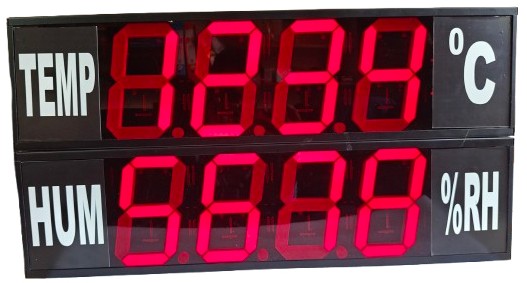
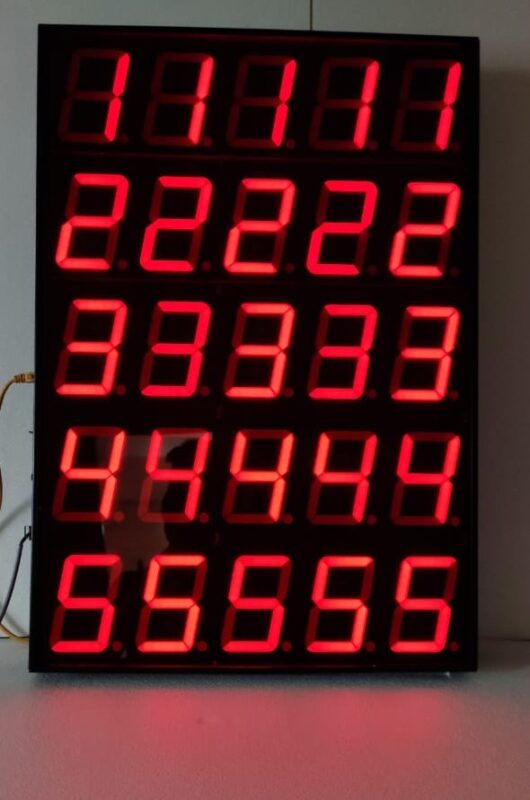
Essential Features of Industrial LED Displays
Commercial televisions or cheap LED monitors fail rapidly in a heavy manufacturing environment. Airborne oil, metal dust, extreme heat, and electrical noise will destroy commercial electronics in months. When specifying a large display for a plant floor, automation architects must look for true industrial-grade features.
Readability at a Distance
The core metric of a Jumbo Display is its viewing distance. A standard rule of thumb is that every 1 inch of digit height equates to roughly 30 to 40 feet of readability. High-intensity LED matrices ensure that the numbers cut through the glare of high-bay factory lighting, remaining perfectly legible from up to 200 feet away.
Rugged Durability
Industrial environments require heavy-duty metal enclosures with proper IP ratings to seal out dust and moisture. The internal electronics must be optically isolated to prevent the massive power surges caused by overhead cranes or heavy presses from traveling up the communication cable and destroying the display’s motherboard.
Multi-Variable Functionality
A premium display shouldn’t just show one static number. It needs the intelligence to toggle between multiple metrics—such as cycling through Temperature, Pressure, and Flow Rate—or to change color (Green to Red) when a specific threshold is breached, instantly acting as a massive visual alarm.
Real-World Applications for Large Digital Displays
The versatility of large-format displays allows them to solve bottlenecks across nearly every industrial vertical:
- Batching and Weighing: In chemical or cement plants, operators loading trucks need to see the live weight from the weighbridge while sitting in their cabins. A Jumbo Display mounted outside provides perfect visibility through the dust, ensuring trucks are loaded to the exact legal limit without over-batching.
- Packaging Lines: Conveyor systems utilizing Shop Floor Scoreboards display the live Takt time. If a jam occurs down the line, the board instantly alerts upstream operators to halt production, preventing a massive pileup of materials.
- Assembly Cells: In automotive or electronics manufacturing, Andon boards track the shift’s progress, highlighting which specific station is holding up the flow, allowing supervisors to dynamically reallocate labor where it is needed most.
True Lean Manufacturing Starts with Visibility
You cannot optimize what you cannot see, and you cannot fix a problem if you don’t know it exists.
Hiding your most critical production data on a small screen severely limits your team’s ability to react, adapt, and succeed. By implementing Industrial Jumbo Displays and modern Andon Boards, you transform passive machine data into an active management tool. You empower your operators, accelerate your maintenance response, and build a culture of absolute transparency and efficiency.
Are you ready to turn your factory’s data into a visible asset? Contact the Samyak Instrumentation engineering team today to specify the perfect ruggedized Jumbo Display or Andon system for your facility’s exact communication protocols.