


Modern industrial facilities run on a complex circulatory system of fluids and gases. From the raw bore-well water entering an Effluent Treatment Plant (ETP) and the caustic solvents dosed into mixing reactors, to the compressed air and nitrogen powering heavy pneumatic machinery, accurately tracking these diverse mediums is the bedrock of operational profitability.
However, Process Engineers often inherit a highly fragmented instrumentation landscape. They are forced to manage magnetic flow meters for water outputting raw high-speed pulses, Coriolis meters for chemicals outputting 4-20mA signals, and vortex meters for utility gases. Managing these disparate signals at the local machine level while simultaneously guaranteeing mathematical accuracy for the central SCADA system requires a unifying piece of hardware.
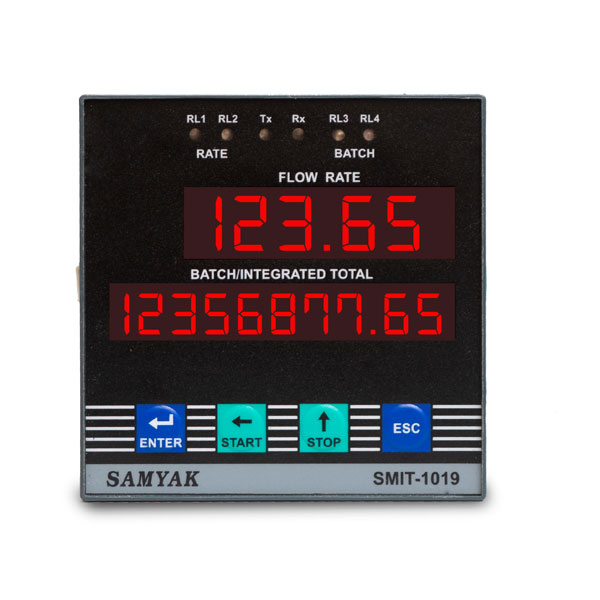
By integrating an industrial Flow Indicator Totalizer—such as the Samyak SMIT 1019—facilities can standardize how they measure, batch, and report every single drop of liquid and cubic meter of gas moving through their infrastructure.
The Core Challenge: Why Flow Rate is Not Enough
The fundamental value of a totalizer lies in its ability to process instantaneous, time-based flow data into actionable, accumulated inventory data.
A standard flow meter output only provides the operator with the instantaneous Flow Rate (e.g., 50 Liters per Minute or 100 Cubic Feet per Minute). While this live metric is essential for monitoring pump health or detecting pipe blockages, a flow rate is completely useless for financial accounting or regulatory compliance.
If a plant manager needs to know exactly how much chemical was consumed during a 12-hour shift for inventory reconciliation, or how much wastewater was discharged to the municipality, they need the Cumulative Total. The Flow Indicator Totalizer mathematically integrates the live flow rate over time, maintaining a highly accurate, non-volatile running total. This dual-display capability—showing both the live speed of the fluid and the historical volume consumed—eliminates manual estimations and provides the exact data required for utility billing.
The Engineering Debate: PLC vs. Dedicated Hardware Totalizer
When designing a new process skid, System Integrators frequently debate whether to wire a flow meter directly into the plant’s main Programmable Logic Controller (PLC) or use a dedicated panel-mounted Flow Totalizer.
Wiring directly to a standard PLC often results in a phenomenon known as “pulse loss” or “volume drift.” Many mechanical flow meters (like turbine or positive displacement meters) output high-speed digital pulses as the fluid turns the internal gears. In high-flow scenarios, these pulses can exceed thousands of hertz (kHz).
A standard industrial PLC operates on a “scan cycle”—reading inputs, executing logic, and updating outputs. If the PLC’s scan time is slower than the incoming pulse frequency from the flow meter, the PLC physically misses pulses. Over a single shift, this missed data compound, resulting in hundreds of liters of untracked fluid.
A dedicated Flow Indicator Totalizer solves this through strict hardware architecture. Units like the SMIT 101 and SMIT 1019 utilize dedicated, hardware-based high-speed interrupt counters that capture every single pulse independently of a logic scan cycle. This guarantees zero pulse loss, ensuring that the total volume displayed on the panel perfectly matches the physical fluid moved through the pipe.
Universal Input Processing and K-Factor Scaling
A true industrial totalizer is defined by its versatility. Automation Architects specify the SMIT 101 because it can adapt to virtually any flow meter technology, regardless of whether the pipe contains a heavy liquid slurry or a high-velocity gas.
Deciphering the Digital Pulse (Liquids)
For water, oils, and chemicals, totalizers seamlessly accept digital pulse inputs. To translate these raw electronic pulses into human-readable engineering units (like Liters or Gallons), the totalizer utilizes a programmable K-Factor. If a turbine meter generates 150 pulses for every exact liter of fluid, the engineer simply programs a K-Factor of 150 into the Samyak totalizer. The internal microprocessor divides the incoming pulses by this factor, displaying mathematically perfect volumetric totals.
Processing Analog Signals (Gases and Vapors)
For compressed air, nitrogen, or steam, field meters frequently output linear analog signals (4-20mA or 0-10V DC) based on the mass or velocity of the gas. The totalizer accepts this analog current, applies programmable zero and span scaling factors, and continuously integrates the signal to accurately accumulate the mass or standard volume of the gas consumed over the shift.
High-Stakes Applications in Liquid Management
Beyond passive monitoring, flow totalizers are actively deployed to solve critical compliance and operational bottlenecks on the factory floor.
Environmental Compliance in ETP/STP
Factories are under strict, escalating government regulations regarding water usage and wastewater discharge. Pollution control boards require exact logs of how much effluent is discharged daily. Utilizing a Flow Totalizer provides an unalterable, cumulative total of discharged water. Because these industrial units retain their memory even during total plant power failures, environmental auditors can trust the displayed values, protecting the facility from severe regulatory fines.
Precision Chemical Batching and Dosing
In food & beverage, pharmaceuticals, or chemical blending, mixing exact ratios of liquids is critical. Relying on an operator to manually watch a flow rate and close a valve is a guaranteed recipe for over-pouring and ruined batches.
By utilizing the programmable relay outputs on the Flow Totalizer, Process Engineers can fully automate the dosing cycle. The operator inputs the target batch volume (e.g., 2,500 Liters) into the totalizer. As the liquid flows, the unit counts up. The exact millisecond the totalizer hits the 2,500-liter mark, its internal relay automatically triggers the feed pump to shut off and the pneumatic valve to close, ensuring perfect batch repeatability without requiring a localized PLC.
Unlocking Hidden Costs in Gas and Utility Tracking
While liquid tracking is critical for production, gas totalization is critical for uncovering hidden financial losses.
Compressed air is widely considered the most expensive utility in a manufacturing plant due to the immense electricity required to run the compressors. By installing a flow meter paired with a Flow Totalizer on the main air header of different production departments, utilities managers can track total cubic feet consumed over a weekend when the plant is idle.
If the totalizer shows massive accumulation during non-production hours, the manager instantly knows that the department has severe pneumatic leaks. Identifying and billing these localized utility costs back to specific departments drives aggressive energy conservation across the facility.
Bridging the OT/IT Gap: SCADA, Modbus, and Samyak RMS Integration
The final architectural function of the Flow Indicator Totalizer is network integration. Many reliable, legacy flow meters scattered across factory floors have zero native communication capabilities. When a facility upgrades to a modern cloud architecture, a central SCADA server, or a dedicated Remote Monitoring System, replacing all these “dumb” field meters with Ethernet-native smart meters is cost-prohibitive.
The Flow Totalizer acts as the digitization bridge. It accepts the raw, localized signal from the field meter, performs the high-speed math locally, and then pushes both the live Flow Rate and the Cumulative Total out via its native RS-485 Modbus RTU port. This allows System Integrators to easily daisy-chain dozens of utility meters across the plant and ingest their data directly into the central control room, or seamlessly push it up to cloud platforms like the Samyak RMS (Remote Monitoring System) for real-time tracking from anywhere in the world.
Whether you are automating a precise chemical batching skid, tracking compressed air usage to uncover leaks, or generating unalterable wastewater discharge logs for environmental compliance, the raw field sensor is only half the solution. By integrating a rugged, universal Flow Indicator Totalizer into your control panels, you guarantee precision high-speed counting, standardize your localized readouts, and seamlessly bridge your fluid data to your modern SCADA network and the Samyak RMS.
Are you looking to standardize your plant’s flow tracking, automate your liquid batching, or bridge your utility data to the cloud? Contact the Samyak Instrumentation engineering team today to specify the perfect Flow Indicator Totalizer for your facility.